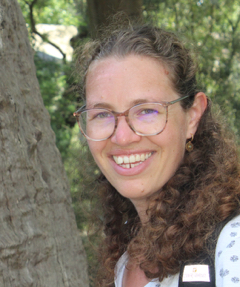
Dr Justine Fasquel is a Research Fellow in the School of Mathematics and Statistics. She works in an area of mathematics called Representation Theory. Part of her work involves separating vector spaces into irreducible parts and categorising those parts. It’s a bit like making LEGO but in reverse - taking a finished structure, breaking it apart into blocks and then organising them into piles of matching blocks. Justine likes sewing her own clothes, which is like doing mathematics but it’s more geometric and more concrete than her usual work! Her favourite piece is a skirt that she made with flowers on it.
What was your relationship with maths and stats like in school?
Maths was my favourite subject at school. It was easy for me. I know it’s not like that for everybody! But I loved it, particularly the equations.
Tell us about a role model you had throughout your journey to become a mathematician/statistician.
At university I found out that I preferred maths more than physics so I followed that direction. I had very supportive PhD supervisors that showed me an idea where I could end up in the future.
What is the best/worst thing about working in maths and stats?
The worst thing is the pressure, there’s a lot of pressure, firstly from ourselves but also because of the system, to prove you deserve your job. Fortunately, this is offset by all the advantages of research. The best thing is the international dimension, being able to meet people and collaborate with people from all over the world and travel is the best! I could never have imagined that I’d get to work in Australia!
What does a typical day as a mathematician/statistician look like?
This semester I didn’t teach, so I had plenty of time for research. I visited Europe for some conferences and then went to Canada and the US to visit some collaborators. When I was teaching, I taught Lie Algebras for Masters students and it was very rewarding.
What do you think is an important skill for a mathematician/statistician?
Being patient and persistent. Most of the time our projects take months or sometimes years, and then when we finish proving something and understand it, we need to write it up and submit it to be published and modify it and that all takes time. In the end it’s worth it!