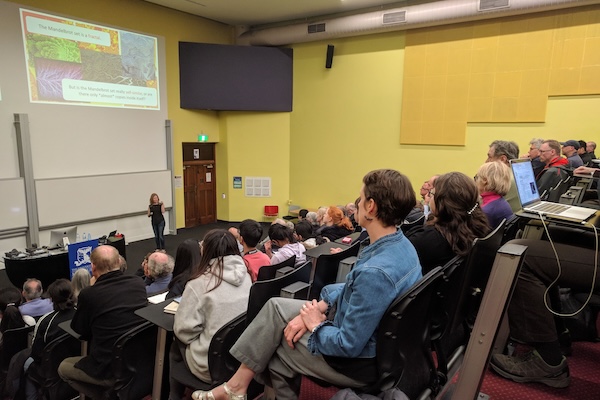
Upcoming lecture
We'll be announcing the 2026 public lecture schedule soon, but if you're interested in getting involved – either as an attendee or a speaker – please get in touch with us on ms-outreach@unimelb.edu.au.
Felix Behrend (1911–1962)
Felix Adalbert Behrend was born on 23 April 1911 at Charlottenburg, Berlin, eldest of four children of Felix Wilhelm Behrend and his wife Maria Sophie, née Zöllner. Although Lutheran, the family had Jewish ancestry. Educated at the Herderschule from 1917, Felix graduated with distinction in 1929 and spent the next four years studying mathematics, physics and philosophy at the University of Berlin (PhD, 1933).
Leaving Germany for England, Behrend went to the University of Cambridge where he worked for eighteen months with the number theorists Harold Davenport and G. H. Hardy. In June 1935 he was employed by a life-insurance company at Zurich, Switzerland, and in October was sent to its branch in Prague. He had decided to settle in Prague when the political events of 1938-39 obliged him to return to Switzerland and then to England.
Arrested as an 'enemy alien' in 1940, Behrend was transported to Australia in the Dunera and interned at Hay and at Orange, New South Wales, and at Tatura, Victoria. Until the end of 1941 he continued to instruct his fellow internees in a scientific programme that covered late secondary and early tertiary mathematics, physics, chemistry and medicine. He taught ordinary differential equations, elementary and advanced vector analysis, projective and differential geometry, complex analysis, and differential and integral calculus.
Acting on advice from the Royal Society, London, the British Home Office authorised Behrend's release from internment. In 1942 he was appointed tutor in the mathematics department at the University of Melbourne.
Promoted to lecturer (1943), senior lecturer (1948) and associate professor (1954), he published sixteen of his twenty-five mathematical papers while in Australia. He worked on the distribution of prime numbers, using Lejeune Dirichlet's series, and on analysis, geometry (the ellipses bounding a given convex set within and without), algebraic equations, the foundations of mathematics and axiomatics. Most of his papers were short, only one exceeding twenty pages. He introduced modern general topology to the university and was an outstanding teacher.
Behrend wrote essays and short stories in German and in English. His children's book, Ulysses' Father (1962), was published posthumously. He loved classical music and had sung bass in the Melbourne Philharmonic Society choir. He died on 27 May 1962 in Epworth Hospital, Richmond. In 1963 the Behrend memorial lecture in mathematics was established at the University of Melbourne with funds provided by his widow.
This biography has been adapted from an article written by James Joseph Cross that was published in the Australian Dictionary of Biography, Volume 13, 1993 and online in 2006.