Upcoming lectures
We'll be announcing the 2026 public lecture schedule soon, but if you're interested in getting involved – either as an attendee or a speaker – please get in touch with us on ms-outreach@unimelb.edu.au.
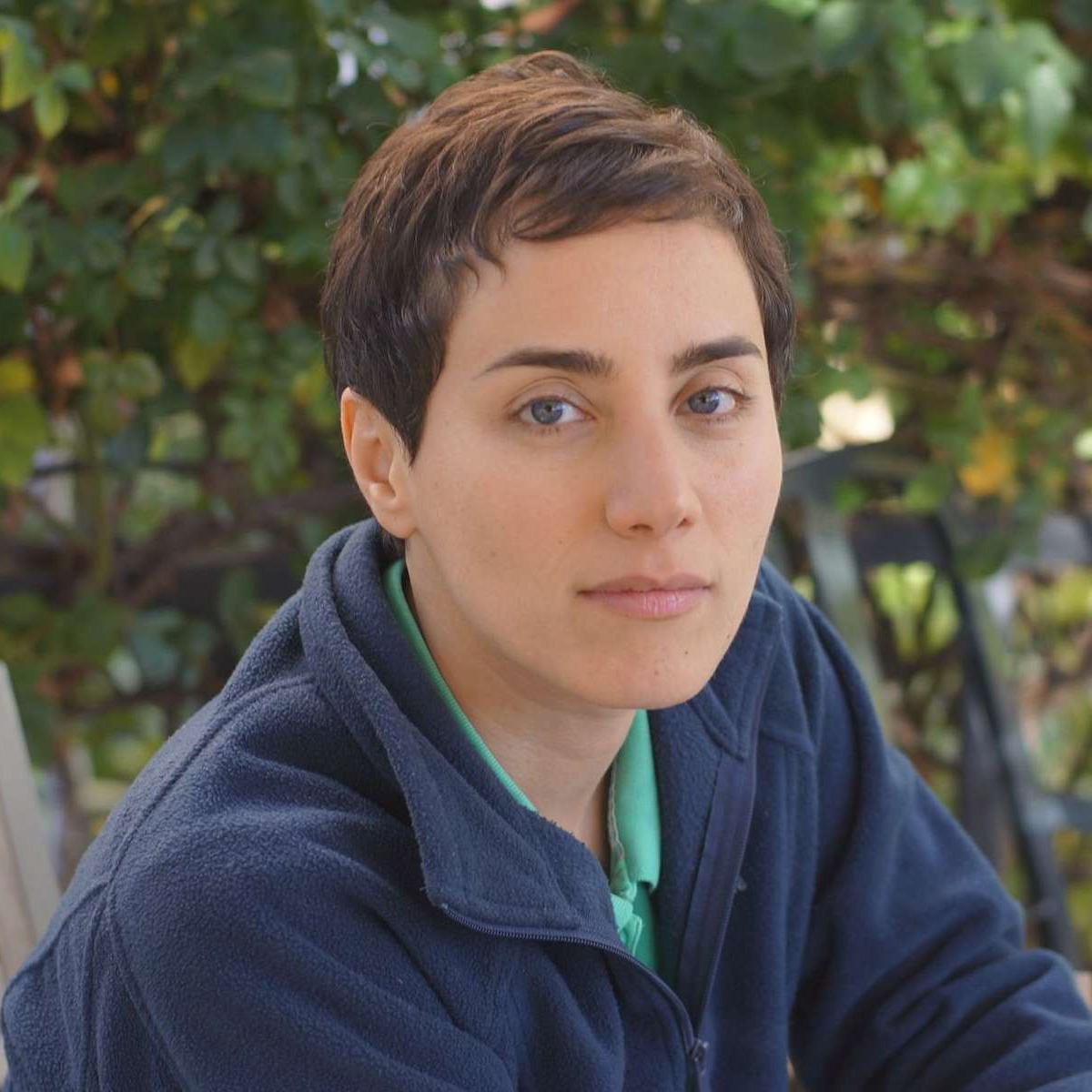
Maryam Mirzakhani (1977–2017)
Maryam Mirzakhani was born in Tehran, Iran on 12 May 1977. She attended Tehran Farzanegan School, part of the National Organisation for Development of Exceptional Talents. During her high school years, she won gold medals at the 1994 and 1995 International Mathematical Olympiads (with a perfect score on the 1995 exam).
In 1999, Mirzakhani obtained a Bachelor of Science degree in mathematics from Sharif University of Technology in Tehran. In 2004 she received her PhD in mathematics from Harvard University with a thesis in hyperbolic geometry entitled "Simple Geodesics on Hyperbolic Surfaces and Volume of the Moduli Space of Curves". Her PhD adviser was Curtis McMullen, who won a Fields Medal in 1998.
From 2004 to 2008, Mirzakhani was a Clay Mathematics Institute Research Fellow and assistant professor of mathematics at Princeton University. In 2009 she joined Stanford University as a full professor of mathematics.
Mirzakhani was one of the world’s leading experts in geometry and dynamical systems. Her work focused on the intricate and complex dynamics of geometric structures, with particular emphasis on moduli spaces and Riemann surfaces. Her approaches and profound insights significantly advanced the field, earning her widespread acclaim and recognition.
She won the 2009 AMS Blumenthal Award, the 2013 AMS Ruth Lyttle Satter Prize in Mathematics, and a Clay Research Award in 2014. In 2014, Mirzakhani was awarded the Fields Medal "for her outstanding contributions to the dynamics and geometry of Riemann surfaces and their moduli spaces." She was the first woman, and the first Iranian, to be awarded the Fields Medal.
Mirzakhani died from cancer on July 15 in 2017 at Stanford Hospital in California at the age of 40.
This biography has been adapted from an article written by Larry Riddle published in Biographies of Women Mathematicians and Wikipedia.
Past lectures
2025: Learn to be a killjoy: How to think like a statistician
Professor Barbara Holland from the University of Tasmania
Barbara talked about three guiding principles and questions to ask when presented with some data.
- Garbage in Garbage Out. Where did the data come from? Did it select itself? Are some of the data missing?
- First rule out the boring explanation. Couldn’t that just be due to chance?
- Correlation doesn’t imply causation. Why is it so hard to know when things cause other things?